Ion spectroscopy
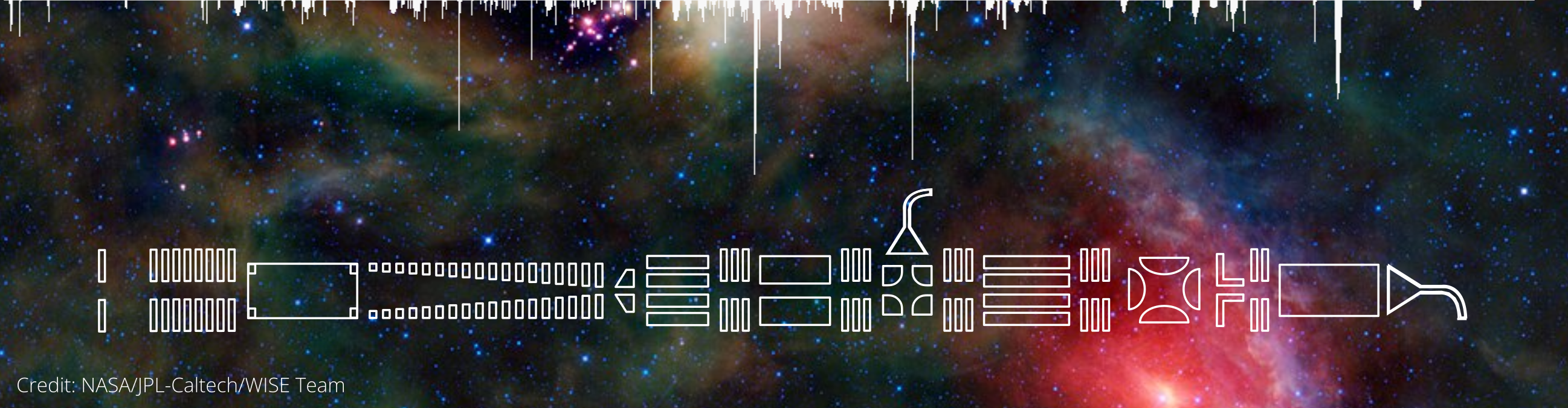
Diffuse Interstellar Bands (DIBs) are among the longest-standing mysteries in astronomy. These unidentified absorption features, observed throughout the interstellar medium, are believed to arise from complex carbon-rich molecules and hold crucial information about the cosmic carbon cycle, interstellar chemistry, and the conditions that precede star and planet formation. Our research aims to identify potential molecular carriers of DIBs by measuring the gas-phase spectroscopic fingerprints of large carbonaceous ions under astrophysically relevant conditions. Using a custom-built instrument that combines mass spectrometry, ion mobility spectrometry, and laser spectroscopy, we obtain spectra from the near-infrared to the ultraviolet range of mass- and shape-selected moleular ions for direct comparison with astronomical observations.
Ion chemistry
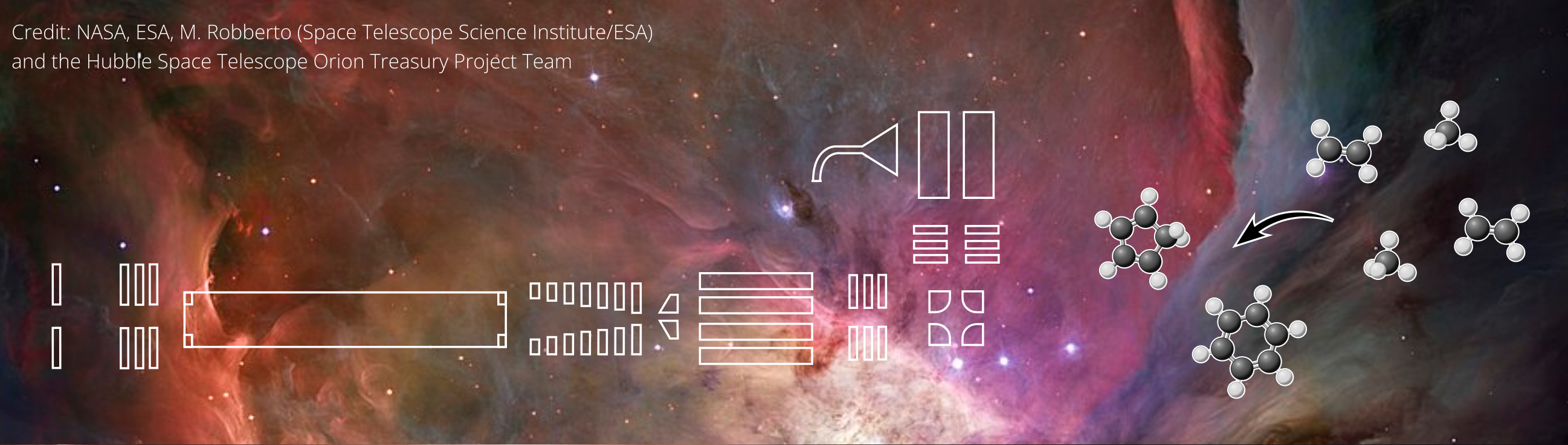
Interstellar molecular clouds host a rich organic chemistry that leads to increasingly complex molecules, including aromatic species considered key intermediates toward prebiotic matter. Yet, current astrochemical models largely rely on isomer-averaged descriptions, overlooking the critical role of molecular structure in governing reaction pathways and branching ratios. We are developing a novel instrument that combines ion mobility spectrometry, mass spectrometry, and ion spectroscopy to establish a structure-resolved framework for interstellar chemistry. By enabling isomer-specific studies of molecular reactivity and reaction kinetics, we will provide direct access to structure-dependent chemical pathways beyond the reach of current astrochemical models, paving the way toward experimentally grounded, structure-resolved astrochemical kinetics.
Neutral chemistry
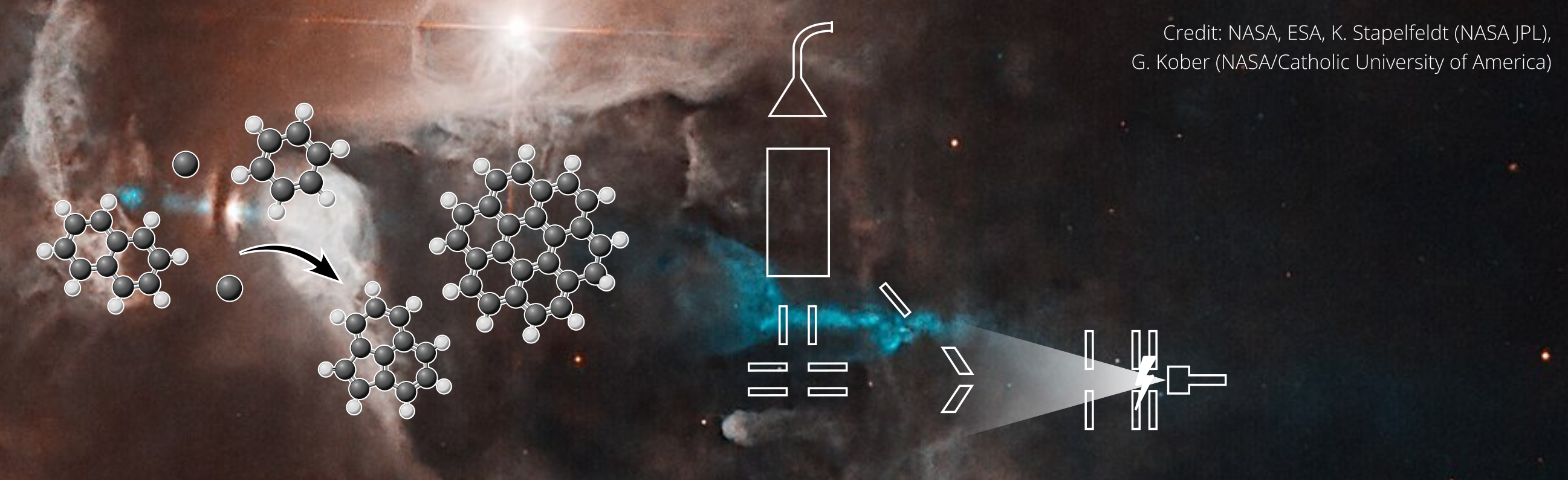
Recent radioastronomical detections of aromatic molecules and small PAHs in dense molecular clouds, particularly in TMC-1, have revealed unexpectedly high abundances that standard astrochemical models cannot reproduce. Although ion–molecule and neutral–neutral chemistry can now account for the formation of benzene and cyclopentadiene, these mechanisms do not explain the efficient production of larger aromatic species. We have shown that sequential atomic carbon addition followed by hydrogenation can drive efficient bottom-up PAH growth in dense clouds, and now seek quantitative experimental data to validate this mechanism. We have a crossed molecular beam experiment to investigate the reactions of atomic carbon with aromatic species. At present, reaction products are probed using fixed-wavelength VUV radiation. The setup will soon be upgraded with a broadly tunable VUV laser, enabling isomer-specific detection of the reaction products..